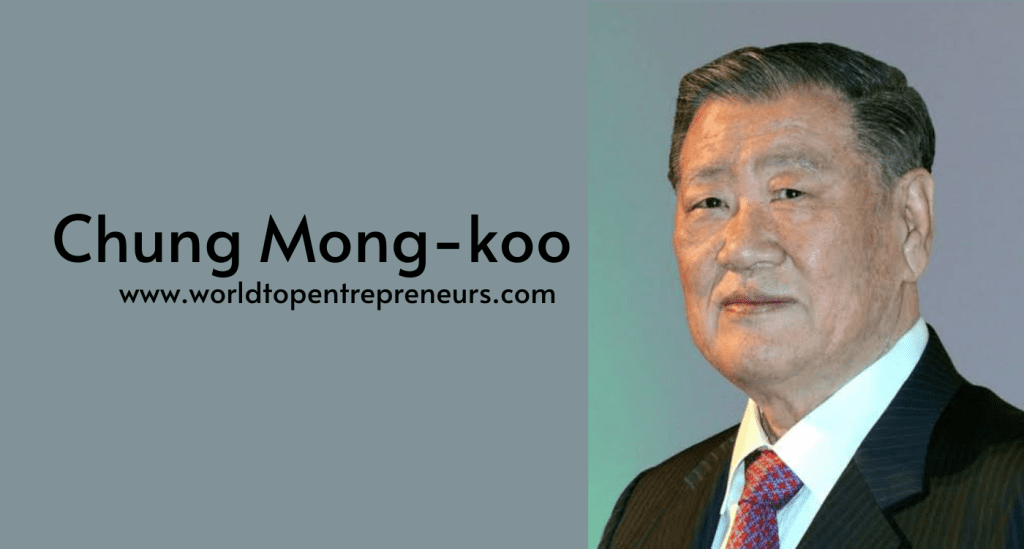
Chung Mong-Koo is a South Korean business magnate and the long-serving former chairman of Hyundai Motor Group, one of the largest and most influential automotive conglomerates in the world. Under his leadership, Hyundai evolved from a regional player into a global powerhouse, transforming not just the company, but the entire automotive industry. Chung’s relentless drive for innovation, efficiency, and quality helped Hyundai Motor become a leader in the automotive world, shaping its destiny for decades to come.
In this blog, we’ll explore Chung Mong-Koo’s early life, his pivotal role in Hyundai’s growth, his leadership style, and his lasting legacy.
Early Life and Background
Born in 1938 in South Korea, Chung Mong-Koo is the son of Chung Ju-Yung, the founder of Hyundai Group, a conglomerate that later split into multiple entities, including Hyundai Motor Company. Chung Mong-Koo grew up in a family deeply rooted in business, with his father being a key figure in South Korea’s rapid industrialization after the Korean War.
Chung attended Yonsei University in Seoul, where he earned a degree in Mechanical Engineering. He later pursued further education in the United States, at University of Michigan, where he earned a Master’s degree in Automotive Engineering. This educational background gave him the technical expertise and global perspective that would shape his future as a leader in the automotive industry.
Upon returning to Korea, Chung Mong-Koo joined Hyundai Motor in the 1960s, where he initially worked in the engineering and production departments. His deep technical knowledge and understanding of automotive engineering set him apart early in his career.
Becoming the Leader of Hyundai Motor Group
In 1999, Chung Mong-Koo became the chairman of Hyundai Motor Group, following the death of his father. At the time, Hyundai was primarily known in South Korea, with only limited global recognition. The company was facing fierce competition from established Japanese and American automakers, and its reputation for quality was still in the process of being established.
Chung recognized that Hyundai needed a bold transformation to not only survive but thrive in the global automotive market. He embarked on a multi-faceted strategy that would define Hyundai’s rise to prominence.
The Transformation of Hyundai Motor
Focus on Quality and Design
One of the first moves Chung Mong-Koo made after taking the helm of Hyundai Motor was to focus intensely on improving the quality of Hyundai cars. During the 1990s, Hyundai cars were often seen as budget-friendly but lower in quality compared to their Japanese and European competitors. Chung was determined to change this perception.
He focused on enhancing Hyundai’s manufacturing processes, implementing strict quality control systems, and making significant investments in research and development (R&D). Under his leadership, Hyundai introduced new models that combined affordable pricing with better quality, gaining the attention of global consumers. Models like the Hyundai Sonata and Hyundai Elantra became popular not just in Korea but across international markets, especially in the United States.
Additionally, Chung made a concerted effort to bring in world-class designers and engineers. One of the key moves was bringing in Peter Schreyer, a renowned German car designer, in the mid-2000s. Schreyer played a pivotal role in redefining Hyundai’s brand identity, creating a more stylish, dynamic design language that would become synonymous with the brand.
By focusing on both quality and design, Hyundai slowly shifted from being a budget car maker to a global contender in the automobile industry.
Expansion of Global Production
Chung Mong-Koo understood that to truly compete globally, Hyundai needed to build a strong presence outside of South Korea. He led the company’s efforts to expand its manufacturing capabilities worldwide. Hyundai began to build production plants in key markets such as the United States, China, and India. This move allowed Hyundai to meet growing demand while reducing shipping costs and import tariffs.
In particular, the construction of a major manufacturing facility in Alabama, USA, in 2005 was a landmark achievement. This facility not only boosted Hyundai’s production capacity but also helped the company avoid high import taxes, allowing Hyundai to offer competitive pricing in the U.S. market. As a result, Hyundai began to establish a strong foothold in North America, a region traditionally dominated by U.S. and European carmakers.
Focus on Innovation and Technology
Under Chung’s leadership, Hyundai also made significant strides in innovation and technology. Chung emphasized the importance of investing in the future, particularly in areas such as hybrid technology, electric vehicles (EVs), and fuel efficiency.
In the 2000s, Hyundai began developing its hybrid vehicles and eventually launched its first electric car, the Hyundai Ioniq. The company also made substantial investments in hydrogen fuel cell technology, positioning Hyundai as a leader in green automotive technologies. The launch of the Hyundai Nexo, a hydrogen-powered SUV, was a testament to the company’s commitment to sustainable transportation.
Furthermore, Chung oversaw the development of Hyundai’s own smart technology solutions, including infotainment systems and advanced driver-assistance systems (ADAS). Hyundai’s Blue Link system, which connects drivers to their vehicles through smartphones, is one example of the company’s push towards more tech-driven and connected vehicles.
The Rise of Kia and the Hyundai-Kia Alliance
Another significant part of Chung Mong-Koo’s legacy is his work with Kia Motors, the second-largest subsidiary under Hyundai Motor Group. Hyundai acquired Kia Motors in 1998, just before the Asian financial crisis, and Chung played a key role in the integration of Kia into the Hyundai Motor family.
Rather than treat Kia as a competitor, Chung focused on creating a synergistic relationship between the two companies. He positioned Kia as a value-oriented brand while Hyundai targeted the mass-market and premium segments. This strategic positioning allowed both brands to grow independently while benefiting from the shared technological advancements, manufacturing efficiencies, and global distribution networks.
Today, the Hyundai-Kia alliance is one of the world’s largest automotive groups, and both brands are recognized for their quality, affordability, and innovation.
Financial Success and Corporate Restructuring
Chung Mong-Koo’s leadership saw Hyundai Motor Group achieve impressive financial growth. By the 2000s, Hyundai was not only one of the largest automakers in South Korea but also one of the top 10 global automakers in terms of production and sales. Under his guidance, the group grew into a conglomerate with several subsidiaries, including Hyundai Heavy Industries, Hyundai Steel, and Hyundai Engineering & Construction.
Chung also oversaw a corporate restructuring aimed at increasing efficiency and reducing costs. This restructuring helped Hyundai stay competitive, particularly during the 2008 global financial crisis, when many global automakers were struggling. Despite the financial difficulties, Hyundai Motor was able to recover quickly, thanks to its solid manufacturing base, diversified product portfolio, and robust global presence.
Legacy and Impact
Chung Mong-Koo’s impact on Hyundai Motor and the automotive industry is nothing short of extraordinary. He transformed Hyundai from a low-cost, low-quality carmaker into a globally recognized brand synonymous with quality, innovation, and value. His strategic focus on design, technology, and globalization helped Hyundai become a leading player in the global automotive market.
His leadership style was marked by a combination of visionary thinking, hands-on management, and a relentless focus on improvement. He fostered a culture of innovation within Hyundai, encouraging both employees and management to always strive for excellence. At the same time, he maintained a tight control over operations, often making key decisions himself.
Although Chung retired from the day-to-day management of Hyundai in 2018, his influence continues to be felt throughout the company. His strategic vision has set Hyundai on a path to becoming a leader in the future of mobility, focusing on electric vehicles, autonomous driving, and sustainable energy.
Conclusion
Chung Mong-Koo is one of the most influential business figures in the global automotive industry. His leadership of Hyundai Motor not only revolutionized the company but also reshaped the automotive landscape. From improving quality and design to expanding globally and driving innovation, Chung’s vision and perseverance have had a lasting impact on Hyundai and the industry at large.
As Hyundai continues to evolve under new leadership, it remains deeply rooted in Chung Mong-Koo’s legacy—committed to excellence, pushing the boundaries of automotive technology, and leading the way in sustainable mobility.