Introduction
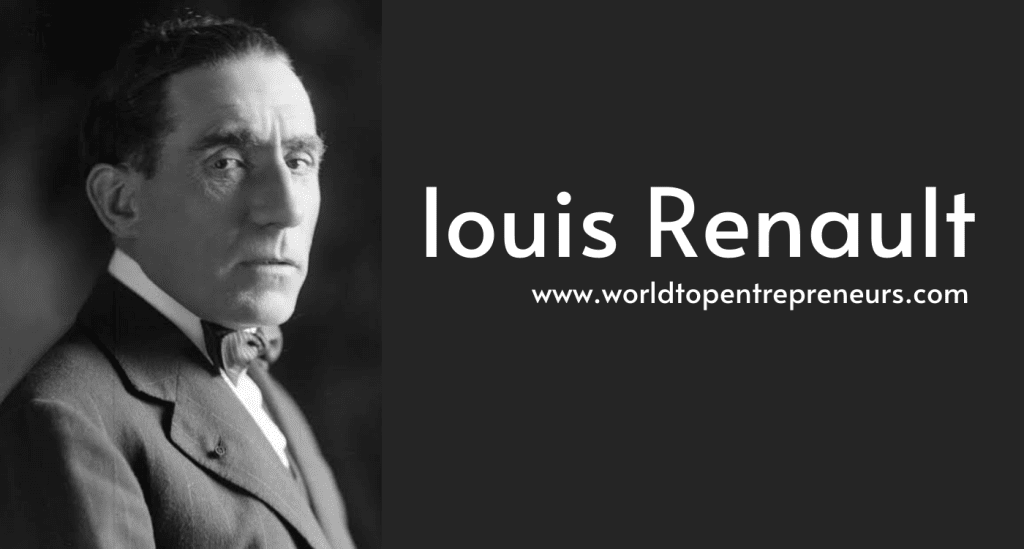
In the world of automotive history, Louis Renault stands as one of the most visionary and influential figures. As the founder of Renault, one of the largest and most prominent car manufacturers in the world today, his contributions not only shaped the future of the company but also revolutionized the automobile industry. His remarkable engineering skills, combined with a relentless pursuit of innovation, led to the creation of groundbreaking vehicles that set new standards for both design and functionality.
Renault’s impact on the automotive world is profound, with its cars being synonymous with performance, style, and technical innovation. Through Louis Renault’s leadership and vision, the company grew from a modest garage operation into a global automobile powerhouse. This blog explores the journey of Louis Renault, his innovations, and the lasting legacy he left on Renault and the automotive industry at large.
Early Life and Career
Born in 1877 in Paris, Louis Renault developed an early interest in engineering. His passion for mechanics was apparent from a young age, and by the time he reached his teenage years, he had already begun experimenting with the construction of mechanical devices. After completing his studies at the École des Arts et Métiers, he decided to focus on automobiles and their potential for transforming transportation.
In the early 1890s, Louis Renault started working at Mors, a French automobile company, but it wasn’t long before he realized that his entrepreneurial spirit was calling him to strike out on his own. In 1899, at the age of 22, he founded Renault Frères alongside his two brothers, Marcel and Fernand, in a small factory in Billancourt, a suburb of Paris.
Louis’ first car design, the Renault Voiturette 1CV, was a breakthrough in compact car design. It featured innovative features for its time, including a three-speed gearbox and an innovative direct-drive system. This small but efficient car quickly gained traction and marked the beginning of Renault’s legacy in the automobile industry.
Revolutionary Engineering and Innovations
Louis Renault’s approach to car manufacturing was deeply rooted in innovation and engineering excellence. His designs were not only visually appealing but also incorporated features that were groundbreaking for the time, pushing the limits of what was technologically possible.
1. The First Production Car with a Direct Drive System (1899)
One of Louis Renault’s first significant innovations came with the development of the direct drive system for his Voiturette. Unlike most cars of the time, which used a chain drive, Renault’s Voiturette was equipped with a more efficient and reliable direct drive, transmitting power directly from the engine to the wheels. This was a precursor to the more advanced drivetrain systems used in modern automobiles.
2. Renault’s Innovations During World War I
During World War I, Renault made significant contributions to military technology. The company produced the Renault FT, a revolutionary light tank that changed the face of armored warfare. The Renault FT was the first-ever fully turreted tank, with a fully rotating turret and a fully rotating chassis. This design would later serve as the foundation for tank designs around the world.
At the same time, Louis Renault continued to focus on improving the commercial success of his passenger vehicles, blending his engineering prowess with strategic business insight to drive the growth of Renault Automobiles.
3. Innovation in Safety and Design: The Renault 40CV
In the early 1920s, Louis Renault and his team introduced the Renault 40CV, one of the first vehicles to be equipped with four-wheel brakes. This innovation drastically improved the vehicle’s handling and safety, marking Renault as a leader in automotive safety. The 40CV became a symbol of luxury and performance in the 1920s and cemented Louis Renault’s reputation for creating cars that were both technologically advanced and visually appealing.
4. The First Car with Independent Suspension: The Renault Nervasport (1930)
Another major milestone in Louis Renault’s engineering career was the Nervasport, introduced in 1930. The Renault Nervasport featured independent suspension, a technology that was revolutionary at the time. Independent suspension would later become a standard feature in most automobiles, significantly improving ride comfort and handling.
Expanding the Renault Brand
Under Louis Renault’s leadership, Renault Automobiles expanded rapidly, and by the early 1900s, the company was producing cars in significant volumes. Renault’s business philosophy focused on producing cars that were not only functional but also affordable to the masses. This focus on mass production helped the company cater to a wide range of customers, from everyday families to high-profile clients, while also positioning Renault as one of the leading car manufacturers in France and Europe.
1. Global Expansion
By the 1920s, Renault had expanded into international markets, setting up production plants in countries such as Belgium, Spain, and Argentina. Louis Renault’s ability to scale up production while maintaining a focus on quality and innovation helped Renault become a global brand.
2. Post-World War II Success
After World War II, Renault continued to thrive under Louis Renault’s leadership, and his designs became even more iconic. The Renault 4CV, introduced in 1947, was a compact car that became immensely popular in Europe due to its affordability and fuel efficiency. The Renault 4 was another groundbreaking model, as it became one of the first affordable four-door hatchbacks in the world.
Challenges and Legacy
Despite his immense success, Louis Renault faced numerous challenges in his later years. In 1945, after World War II, Louis Renault was accused of collaborating with the Nazi regime during the German occupation of France, particularly due to his work with the German military during the war. As a result, the French government seized Renault’s assets, and Louis Renault was arrested. Louis Renault died in 1944 under mysterious circumstances before he could stand trial, and the company was nationalized in 1945.
However, despite these controversies, Louis Renault‘s contributions to the automotive world remained undeniable. Renault‘s continued innovation, technological advancements, and commitment to quality and safety were direct reflections of his influence. Today, Renault remains a major player in the automotive industry, with a reputation for producing innovative, affordable, and high-performance vehicles.
Conclusion
Louis Renault was a true pioneer in the automotive world. From his early breakthroughs in car engineering to his innovations in safety, design, and manufacturing, his contributions laid the foundation for the success of Renault Automobiles. Despite facing challenges, including the controversy surrounding his later years, Louis Renault‘s vision and ingenuity continue to influence the brand to this day.
Through Louis Renault’s legacy, Renault has become a symbol of French engineering excellence, creativity, and progress, with vehicles that are admired worldwide. Today, Renault continues to innovate in the fields of electric vehicles, autonomous driving, and sustainable mobility, proving that the spirit of Louis Renault lives on in every car that bears his name.