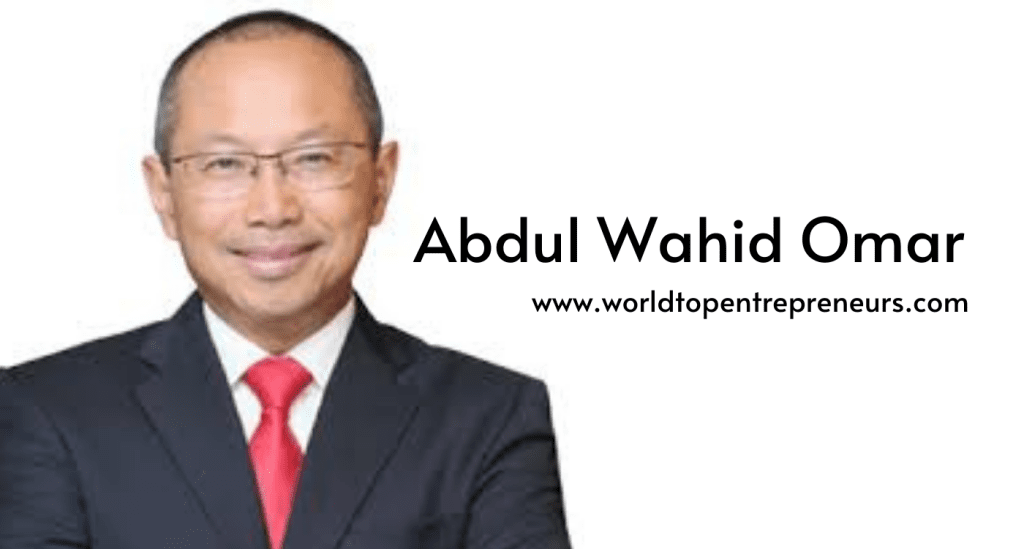
Abdul Wahid Omar is one of Malaysia’s most respected business leaders, best known for his exceptional leadership in the corporate world. His entrepreneurial journey spans various prestigious roles in top companies, and his significant contributions to Bursa Malaysia, the Malaysian stock exchange, have helped shape the country’s financial market landscape.
As a seasoned executive with a wealth of experience in finance, telecommunications, and investment, Abdul Wahid has demonstrated resilience, vision, and a strong commitment to driving corporate success. In this blog, we will explore Abdul Wahid Omar’s entrepreneurial journey, his educational background, business experiences, struggles, successes, and his transformative influence at Bursa Malaysia and beyond.
Early Life and Educational Background
Abdul Wahid Omar’s path to success began with a solid educational foundation. He was born in Malaysia and raised with a strong emphasis on education and hard work. Abdul Wahid pursued his higher education at University of Nottingham, where he earned a Bachelor’s degree in Economics. His academic journey not only provided him with essential knowledge in finance and economics but also sparked his interest in business management.
After completing his undergraduate degree, Abdul Wahid went on to further his studies with an MBA (Master of Business Administration) from The University of Manchester in the United Kingdom. This combination of economics and business management studies equipped him with the expertise to navigate the complex world of finance and investments.
Career Beginnings: Stepping Into the Corporate World
Abdul Wahid Omar’s professional career began shortly after completing his studies. He joined Peat Marwick (now KPMG), one of the leading accounting and consulting firms, where he gained valuable experience in financial auditing and corporate advisory. His time at Peat Marwick allowed him to develop a deep understanding of business operations, financial strategies, and governance practices, which became essential as he moved forward in his career.
However, his true entrepreneurial spirit came to the forefront when he shifted his focus to the corporate sector. In the early 1990s, Abdul Wahid joined Telekom Malaysia, the country’s largest telecommunications company, where he would begin to make his mark.
Transforming Telekom Malaysia and Axiata Group
Abdul Wahid’s career truly took off when he joined Telekom Malaysia (TM) in 1995. Initially appointed as Chief Operating Officer, he rose through the ranks to become the Chief Executive Officer (CEO) of the company in 2004. His time at TM was marked by significant transformation and a period of substantial growth.
Telecom Industry Leadership
Under Abdul Wahid’s leadership, Telekom Malaysia underwent a major restructuring that helped modernize the telecommunications infrastructure in Malaysia. He introduced strategic reforms, improved customer service, and made significant investments in broadband development, laying the groundwork for Malaysia’s modern telecommunications network.
However, Abdul Wahid’s most notable contribution to Telekom Malaysia was his role in its regional expansion. He was a key figure in the de-merger of TM’s mobile arm into a separate entity, which later became Celcom. His efforts in positioning TM for international expansion, particularly in the ASEAN region, helped secure TM’s place as one of Southeast Asia’s leading telecom companies.
In 2008, he played an instrumental role in transforming TM into a more diversified technology and communications conglomerate. His forward-thinking approach was evident as he expanded the company’s reach beyond just telecommunications into internet services, infrastructure, and global connectivity.
Axiata Group Berhad
In 2008, Abdul Wahid made a significant move when he became the CEO of Axiata Group Berhad, the parent company of Celcom, one of Southeast Asia’s leading mobile operators. Under his leadership, Axiata expanded its presence in Southeast Asia, South Asia, and beyond, growing into a regional telecom powerhouse.
Abdul Wahid oversaw Axiata’s multi-billion-dollar investments in countries like Indonesia, Sri Lanka, and Bangladesh, making it one of the largest telecommunications companies in the region. He also led the successful listing of Axiata on the Bursa Malaysia, elevating the company to one of the most valuable public companies in Malaysia.
During his tenure at Axiata, Abdul Wahid was credited with diversifying the business and driving significant revenue growth through strategic acquisitions and partnerships. His focus on customer satisfaction, innovation, and long-term growth made Axiata one of the most prominent companies in the telecom sector.
Transition to Bursa Malaysia
In 2012, Abdul Wahid Omar took on one of his most challenging and influential roles: CEO of Bursa Malaysia, the Malaysian stock exchange. His entry into Bursa was seen as a bold move, as he transitioned from the highly competitive telecommunications industry into the world of financial markets.
At Bursa Malaysia, Abdul Wahid was tasked with modernizing the stock exchange and enhancing its position on the global stage. He knew that for Bursa Malaysia to stay relevant in the increasingly competitive global marketplace, it needed to embrace technological innovation, diversify its offerings, and attract new investors.
Modernizing Bursa Malaysia
Under Abdul Wahid’s leadership, Bursa Malaysia underwent significant changes, including:
- Digitization and Technology: Abdul Wahid focused on modernizing Bursa’s technology infrastructure to improve trading efficiency, market transparency, and investor access. He implemented new digital platforms that allowed retail and institutional investors to engage more easily with the market.
- Diversification of Products: He spearheaded initiatives to broaden the range of financial products available on the exchange, including derivatives, structured products, and Islamic financial instruments. This helped make Bursa Malaysia a more attractive exchange for global investors looking for diverse investment options.
- Increased Market Liquidity: Abdul Wahid also worked on increasing the liquidity of the Malaysian stock market by encouraging both local and foreign investment. He actively sought to improve market conditions through greater transparency, investor education, and the introduction of reforms to enhance market integrity.
- Globalization: Recognizing the importance of Bursa Malaysia’s presence on the global stage, Abdul Wahid worked on fostering partnerships with international financial institutions and encouraging foreign companies to list in Malaysia. His efforts helped elevate the visibility of Bursa Malaysia and establish it as a key player in the ASEAN region.
Struggles and Challenges
Like many corporate leaders, Abdul Wahid faced his share of struggles and challenges throughout his career:
- Telecom Sector Competition: The telecommunications industry was highly competitive, with new players and rapid technological advancements. His ability to keep Telekom Malaysia and Celcom ahead of the competition required constant adaptation and strategic decision-making.
- Market Volatility: At Bursa Malaysia, Abdul Wahid navigated the challenges of market volatility, especially during times of global economic uncertainty. Maintaining investor confidence during periods of financial instability required careful management and strategic thinking.
- Technological Challenges: As he led Bursa Malaysia’s digital transformation, Abdul Wahid faced the challenge of implementing cutting-edge technologies in a market that was often resistant to change. The push for innovation had to be balanced with ensuring the security and integrity of the exchange.
- Cultural Shifts: Managing the cultural transformation at Axiata, Telekom Malaysia, and Bursa Malaysia was also a key challenge. Shifting organizational mindsets towards innovation, customer-centricity, and global expansion required leadership and vision.
Successes and Achievements
Abdul Wahid Omar’s career is a testament to his resilience, strategic vision, and ability to drive growth even in the most challenging environments. Some of his key successes include:
- Transforming Telekom Malaysia: His leadership helped reposition Telekom Malaysia as a leading regional player in telecommunications, with a focus on broadband and global expansion.
- Building Axiata Group: Under his leadership, Axiata became one of Southeast Asia’s largest telecommunications conglomerates, with a strong regional presence and impressive financial performance.
- Modernizing Bursa Malaysia: As CEO of Bursa Malaysia, Abdul Wahid successfully modernized the stock exchange, introduced innovative products, and improved its global competitiveness, solidifying his position as a visionary leader in the financial sector.
- Industry Recognition: Abdul Wahid has received numerous accolades for his leadership and contributions to the corporate world, including recognition as one of Malaysia’s top business executives.
Conclusion
Abdul Wahid Omar’s entrepreneurial journey is an inspiring story of leadership, vision, and transformation. From his early days in telecommunications to his groundbreaking work at Bursa Malaysia, he has continually demonstrated his ability to drive growth, adapt to changing markets, and create lasting value for the companies he led.
His impact on Malaysia’s corporate and financial sectors cannot be overstated. Today, Abdul Wahid Omar stands as a role model for future entrepreneurs and business leaders, demonstrating the power of strategic vision, resilience, and an unwavering commitment to excellence.