Introduction:
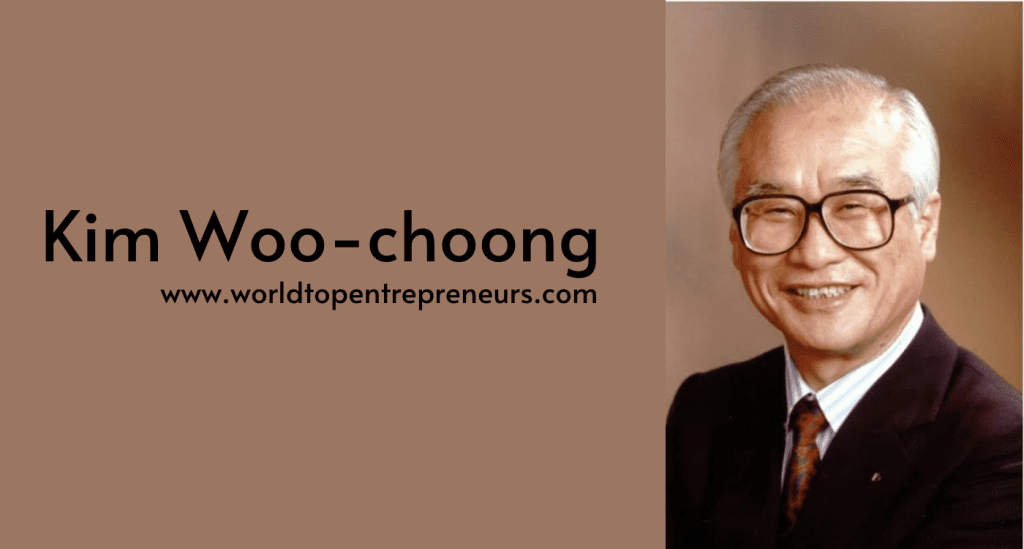
Kim Woo-Choong, the founder of Daewoo Group, was a key figure in South Korea’s rapid industrialization and economic transformation during the latter half of the 20th century. His journey from a small business entrepreneur to leading one of the largest conglomerates in South Korea’s history is a remarkable tale of ambition, resilience, and vision. Under his leadership, Daewoo Group became a powerhouse in multiple sectors, including automotive, shipbuilding, electronic, construction, and finance.
In this blog, we will explore Kim Woo-Choong’s life, his role in establishing Daewoo Group, and the lasting impact of his leadership on South Korea’s economic development and the global marketplace.
Early Life and Background:
Kim Woo-Choong was born in 1936 in South Korea, in a time when the country was still recovering from the effects of war and occupation. Raised in a modest family, Kim had a humble beginning and initially pursued his education in business. After earning a degree in economics from Kyunggi University, Kim Woo-Choong briefly worked for a small textile company, but his entrepreneurial spirit soon led him to start his own business.
In 1967, at the age of 31, Kim founded Daewoo Industrial, which marked the beginning of his long journey in building a global conglomerate. His ambition was to create a company that could not only compete in South Korea’s domestic market but could also take on international markets and help drive the country’s economic rise.
The Rise of Daewoo Group: Expansion into Multiple Industries
Daewoo Group’s ascent under Kim Woo-Choong was rapid and marked by aggressive expansion into a wide range of industries. While many South Korean conglomerates focused primarily on one or two sectors, Kim’s strategy was to create a highly diversified group of companies. The result was the growth of Daewoo Group into one of the largest and most influential business conglomerates in the world by the 1980s and 1990s.
Automotive Industry: Daewoo Motors
One of Kim Woo-Choong’s most notable achievements was Daewoo’s expansion into the automotive industry. In the 1970s, South Korea’s automotive industry was in its infancy, but Kim saw a huge opportunity in it. In 1978, Daewoo established its automobile manufacturing division, Daewoo Motors, after acquiring SOUTH KOREAN automaker Saehan Motor.
Under Kim’s leadership, Daewoo Motors grew rapidly, producing a wide range of vehicles, from compact cars to commercial trucks. The company aimed to produce affordable, high-quality cars for the South Korean market and for export. By the 1980s, Daewoo had become one of the leading car manufacturers in South Korea, with its cars exported to numerous countries.
In the 1990s, Daewoo Motors became one of the largest global players in the automotive market, with key partnerships and joint ventures with major international car manufacturers. However, financial difficulties and mismanagement in the later years led to the eventual sale of Daewoo Motors to General Motors in 2002, but the company’s early success remains a testament to Kim Woo-Choong’s strategic vision.
Shipbuilding and Heavy Industry:
In addition to automotive, Kim Woo-Choong also recognized the potential of South Korea’s shipbuilding and heavy industries. Through Daewoo’s subsidiary, Daewoo Shipbuilding & Marine Engineering (DSME), the company quickly became a leader in the global shipbuilding industry. In the 1980s, DSME was known for its expertise in building massive container ships, oil tankers, and naval vessels. The company played a significant role in driving South Korea’s rise as a major player in global shipbuilding.
Daewoo also expanded into construction, electronics, and machinery, further cementing its position as a diversified conglomerate. With Kim’s leadership, Daewoo’s influence spread across multiple industries, making it a symbol of South Korea’s rapid economic progress.
Electronics and Telecom:
Kim Woo-Choong was also keen on expanding Daewoo’s footprint in consumer electronics and telecommunications. The company entered the electronics sector by manufacturing a wide range of products, including televisions, home appliances, and audio systems. Daewoo also ventured into telecommunications by establishing Daewoo Telecom, helping to bring advanced communication technologies to South Korea.
While Daewoo’s electronic products and telecommunications operations were initially successful, the challenges of competing with global giants like Samsung and LG in the 1990s led to a gradual decline in its position in these industries.
Kim Woo-Choong’s Business Philosophy: Aggressive Expansion and Global Ambition
Kim Woo-Choong’s philosophy of aggressive expansion and global ambition became hallmarks of his leadership. He was known for his willingness to take risks and his unwavering confidence that Daewoo could compete with the best in the world. His leadership style was characterized by bold moves, such as making substantial investments in industries that were in their early stages of development in South Korea, including the automotive, shipbuilding, and electronics sectors.
One of Kim’s core beliefs was that in order to build a global empire, Daewoo needed to diversify across multiple sectors. This meant that Daewoo was involved in almost every major industry, from construction to finance, and from heavy industry to consumer goods. His strategy of diversification allowed Daewoo to weather economic downturns in one sector by relying on profits from others.
Furthermore, Kim Woo-Choong focused heavily on internationalization. He envisioned Daewoo as not just a South Korean company, but a global corporation. Daewoo expanded into global markets, including Europe, Africa, and the Middle East, establishing joint ventures and acquiring foreign companies to strengthen its international presence.
The Collapse of Daewoo Group and Kim Woo-Choong’s Downfall:
Despite Kim Woo-Choong’s early success, Daewoo Group’s story took a sharp turn in the late 1990s. By the time of the Asian Financial Crisis in 1997, Daewoo was one of the largest conglomerates in South Korea, but it was also heavily indebted. The company’s aggressive expansion and reliance on high-risk financial strategies, including borrowing, ultimately led to its downfall.
In 1999, Daewoo Group was forced to declare bankruptcy after it failed to repay its debts, marking the end of an era for the conglomerate. Kim Woo-Choong was charged with embezzlement and fraud, though he fled to France to avoid prosecution. His departure and the collapse of Daewoo Group sent shockwaves throughout South Korea, and the once-mighty conglomerate was dismantled and sold off to various other companies, including General Motors and Hyundai.
Kim eventually returned to South Korea in 2007, where he faced charges related to his role in the collapse of Daewoo. Despite his legal troubles, Kim Woo-Choong’s legacy as one of South Korea’s pioneering business figures remains intact, as his contributions to the country’s industrialization and global economic position were undeniable.
Legacy and Impact on South Korea’s Economy:
Kim Woo-Choong’s legacy is deeply intertwined with South Korea’s post-war economic development. His leadership of Daewoo Group helped transform South Korea into an industrial powerhouse, capable of competing with global giants in several critical industries. While Daewoo’s downfall was a significant chapter in South Korea’s business history, Kim Woo-Choong’s influence on the country’s economic growth remains profound.
Under his direction, Daewoo helped lay the foundation for South Korea’s success in shipbuilding, automotive manufacturing, and electronics. His bold vision, willingness to take risks, and global ambition provided a blueprint for other South Korean conglomerates, including Samsung, Hyundai, and LG, to expand internationally and achieve success.
Though his career was marked by both incredible success and dramatic failure, Kim Woo-Choong’s role in shaping South Korea’s economy and his contributions to the rise of Daewoo Group remain pivotal in the country’s rise as a global economic force.
Conclusion:
Kim Woo-Choong’s entrepreneurial journey is a testament to the power of vision and ambition. As the founder of Daewoo Group, he helped transform South Korea into one of the world’s leading industrial nations. His role in shaping industries like automotive manufacturing, shipbuilding, electronics, and construction has left a lasting impact on the global business landscape.
While Daewoo Group’s eventual collapse marked the end of a chapter for Kim Woo-Choong, his contributions to South Korea’s economic development are still remembered as part of the nation’s remarkable rise. Kim’s legacy endures as a reminder of the transformative power of business leadership, vision, and boldness.