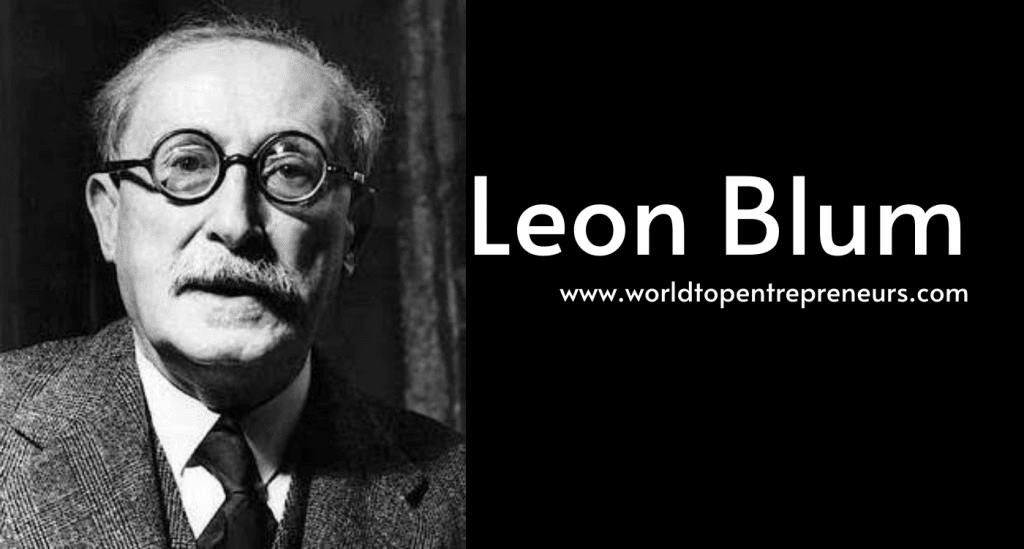
Introduction to Léon Blum
Léon Blum, one of the most influential political figures in 20th-century France, was a socialist leader whose career spanned several pivotal moments in the country’s history. His work as a politician, intellectual, and advocate for social justice deeply impacted the course of French politics and shaped the socialist movement in Europe. Blum was instrumental in the establishment of France’s Popular Front government in the 1930s, and his legacy is still felt in modern French politics.
In this blog, we explore the life, career, and political philosophy of Léon Blum, a figure whose ideas and leadership not only changed France but also left a lasting mark on European and world history.
Early Life and Intellectual Formation
Léon Blum was born on April 9, 1872, in Paris, France, into a middle-class Jewish family. Raised in an environment that valued intellectual pursuits, Blum was a brilliant student and showed an early aptitude for learning. He entered the École Normale Supérieure, one of France’s most prestigious educational institutions, where he studied philosophy, history, and literature. His intellectual formation played a significant role in shaping his later political views, which were heavily influenced by humanism, justice, and equality.
Blum initially embarked on a career as a writer and literary critic, contributing to various journals and magazines. However, as he matured, he increasingly turned his attention to politics, drawn by a desire to address social inequality and fight for the rights of the working class. His academic background in philosophy and his deep understanding of the social dynamics of his time would lay the foundation for his future political ideologies.
Entry into Politics and the Rise of Socialism
Léon Blum’s transition from intellectualism to politics came during a period of significant social and political upheaval in France. In the late 19th and early 20th centuries, France was experiencing major labor movements, strikes, and growing political polarization. Blum, who had become politically active through his involvement with socialist organizations, joined the French Section of the Workers’ International (SFIO), a political party that advocated for socialism, workers’ rights, and democratic reforms.
Blum quickly rose through the ranks of the SFIO due to his eloquent oratory skills, deep intellectual grounding, and passion for social justice. He was elected to the Chamber of Deputies in 1919, marking the beginning of his long and influential political career. As a member of the SFIO, Blum worked on issues like labor rights, social security, and education, pushing for progressive reforms in an effort to improve the lives of the working class.
Léon Blum and the Popular Front
The pinnacle of Blum’s political career came in the 1930s during the formation of the Popular Front, a broad coalition of left-wing parties that united under the banner of socialist, communist, and radical elements to challenge the rise of fascism in Europe. The Popular Front was a response to the growing threat of extreme right-wing movements, particularly in Italy and Germany, and the economic crisis caused by the Great Depression.
In 1936, Blum became the first Jewish Prime Minister of France when he led the Popular Front government to victory in the French legislative elections. This was a remarkable achievement, as Blum’s government represented a unified front of left-wing factions—including the French Communist Party—against the conservative establishment. Blum’s rise to power was a triumph for progressive politics in France and marked a significant shift to the left in the country’s political landscape.
Major Reforms and Policies Under Blum’s Leadership
As Prime Minister, Blum’s government enacted a number of landmark reforms that had a lasting impact on French society. His leadership ushered in a period of progressive changes aimed at improving the social and economic conditions of the working class. Some of the key reforms of Blum’s tenure include:
- The 40-Hour Work Week: One of the most significant achievements of the Blum government was the introduction of the 40-hour workweek, which limited working hours and allowed workers more time for rest and family life. This reform was part of a broader effort to improve working conditions and reduce labor exploitation.
- Paid Vacations for Workers: Blum’s government introduced the concept of paid vacation time for workers, granting them a minimum of two weeks off each year. This was a revolutionary policy that ensured that workers could take time off without losing income, improving their quality of life.
- Collective Bargaining Rights: Blum’s administration also made it easier for workers to form unions and engage in collective bargaining with employers, a move that empowered workers and improved their ability to negotiate for better wages and working conditions.
- Social Welfare Reforms: Under Blum’s leadership, the government expanded social welfare programs, including health care, pensions, and unemployment benefits. These programs aimed to provide a safety net for the working class and reduce inequality in French society.
- Support for the Arts: Blum’s government was also notable for its support of the arts and culture, and during his time in power, several cultural initiatives were introduced. This reflected his belief in the importance of culture and intellectual life in the socialist vision of society.
Despite these progressive measures, Blum’s government faced fierce opposition from conservative factions, business leaders, and the military. The French right wing was deeply hostile to his policies, which they viewed as socialist and detrimental to the capitalist system. This opposition, combined with economic challenges and political instability, led to the collapse of Blum’s government in 1937.
The Legacy of Léon Blum
Although Blum’s time as prime minister was brief, his legacy endures in the history of French socialism and European politics. Blum’s government represents a moment when socialist ideals were put into practice on a national scale, and many of his reforms laid the groundwork for the development of the modern welfare state in France.
After his time in office, Blum continued to be an influential figure in French politics, particularly as a vocal opponent of fascism and the rise of Nazi Germany. During World War II, Blum was arrested by the Vichy regime and imprisoned for his political beliefs. Despite his imprisonment and the challenges he faced in the years following the war, Blum remained a symbol of progressive politics and social justice.
Blum’s contributions to the socialist movement and his role in the Popular Front are still remembered today. He is often regarded as one of the most important figures in French political history, and his advocacy for the working class, civil rights, and social justice continues to inspire political movements worldwide.
Conclusion
Léon Blum was a visionary leader whose political career helped shape the course of modern France. His dedication to socialist ideals and his pioneering reforms in labor rights, social welfare, and civil liberties made him a transformative figure in French politics. Blum’s leadership of the Popular Front and his ability to unite disparate factions around progressive causes stands as a testament to his political skill and vision.
Today, Blum’s legacy endures as a symbol of progressive governance, social justice, and the power of solidarity in the face of adversity. Though his tenure as prime minister was brief, his impact on French society and politics remains profound, and his contributions to the welfare of the working class continue to be celebrated.